July 14, 2026
The AI Readiness Playbook for Product Teams (Part 1 of 3)
Get Your House in Order
We’ve all heard the “we need AI” corporate mandate in some variation. But that's not a strategy, a vision, or useful. Somewhere between the executive proclamation and the actual agent doing work is a real gap where a leap of faith is taken.
There's plenty written about AI governance (e.g., risk, access, responsible use). There's plenty written about AI tooling (e.g., LLMs, agents, harnesses, applications). What's missing is the bridge between the two. This three-part article (Part 2, Part 3) is that bridge based on a B2B SaaS agile product operations model that’s also extensible with other business and operating models. Warning: I’m not going to talk about AI much. This is about good business practice, which AI happens to reward.
Let’s dig in!
The Roadmap
The goal, stated plainly: I will build an AI agent/workflow to do X, for Y, using context from 1, 2, and 3, to achieve A, which will impact B.
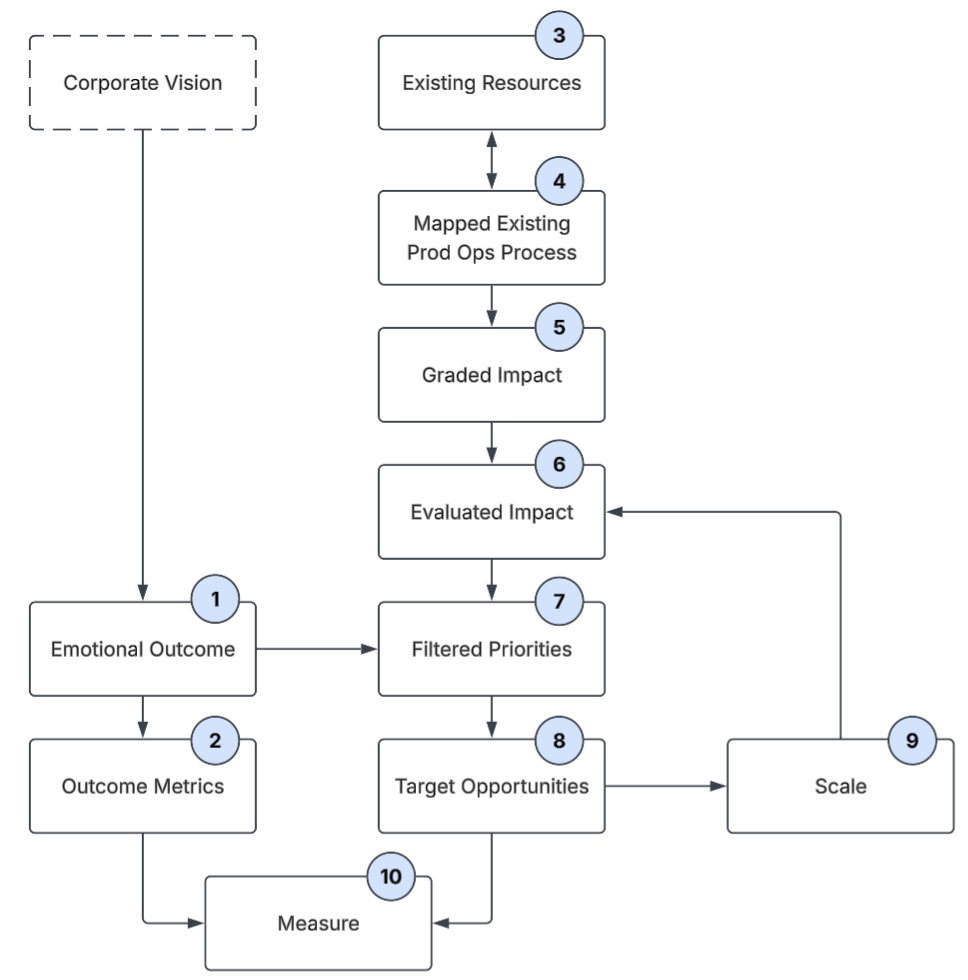
If you can't fill in this sentence yet, you're not ready to pick a tool. You're ready for this article. The diagram below is where we’re headed over the next 3 articles. I’ll break down each step, but the culmination will help you think about how and why AI agents and workflows can drive results towards your goals.
Step 1: Define the "ideal" state starting with a feeling—not a metric
Here's where planning exercises can lose touch with reality: they jump straight to KPIs (that’s hard for me to say because I live for a solid KPI). I'd argue you should start somewhere softer with the emotional state you'd be proud of. Culture and efficiency are experienced emotionally before they're measured logically, if ever measured (a.k.a. the eye test). If the feeling isn't there, no amount of dashboard green status will convince you it's working. (For anime fans, there's a series where 2 scientists try to reduce love to a formula: Science Fell in Love, So I Tried to Prove It. Spoiler: formulas don't do feelings justice. Neither do metrics, until you've named the feeling first.) State that feeling without overthinking it.
Take this example:
"Cross-functional PDLC stakeholders need to feel confident in what we launch without burdening the PM team with constant hand-holding."
These aren’t metrics… yet. Break this down into its components:
- Cross-functional audience → information needs to reach non-R&D teams
- Stakeholders feel confident → predictable timing, MVP clarity, a value story, tested use cases, known tradeoffs
- Don't burden PMs → PMs shouldn't be the bottleneck or constant translator
- Minimize hand-holding → the process should be repeatable for scale
Notice what this example outcome is not about: delivery speed. Rather, it's about accountability and predictability; what goes into the PM function, what comes out, and whether PM can handle that flow without becoming a chokepoint. Don’t try to force something in if it didn’t come naturally in your original outcome.
Step 2: Attach metrics to the feeling—not the other way around
Once you've named the outcome and broken it into components, you assign measuring sticks. Think of this the same way you'd decompose a product vision into tangible pieces and measures. A few general operational measures I keep coming back to: PM team satisfaction, stakeholder satisfaction (e.g., pulse checks on launch confidence), overtime hours, ad hoc Slack inquiries, scope creep (e.g., planned vs. delivered story points), roadmap delivery efficiency, feature request response time, and self-serve dashboard views. Treat this as a menu, not a checklist. Pull two or three that map cleanly to each outcome’s component.
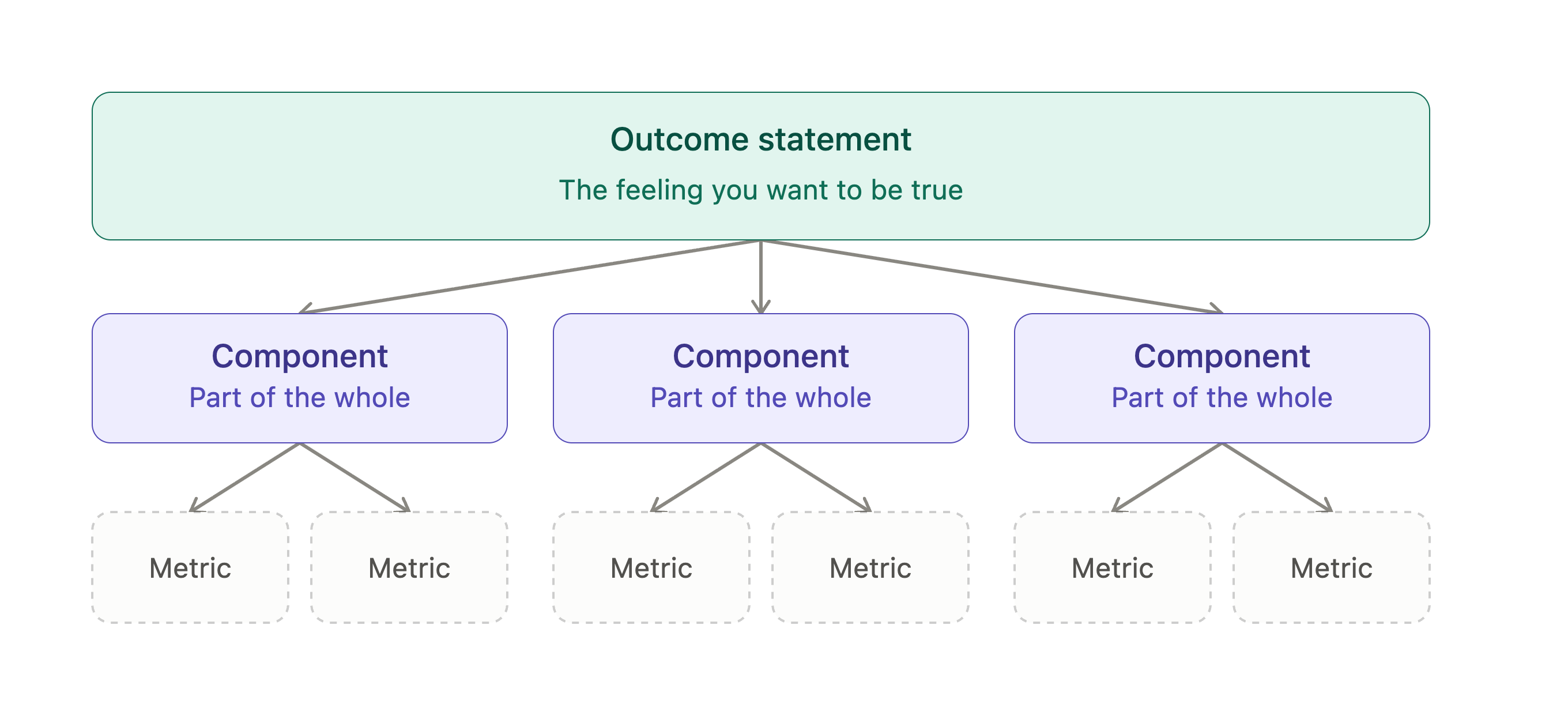
For the example above:
| Outcome factor | Candidate metrics |
|---|---|
| Cross-functional audience | Stakeholder SAT, launch checklist completion %, feature request response time |
| Stakeholders feel confident | Launch checklist completion %, lead time (staging deploy → GA), ad hoc inquiries |
| Don't burden PMs | PM SAT, overtime hours, ad hoc inquiries |
| Minimize hand-holding | Self-serve dashboard views, ad hoc inquiries, feature request response time |
To provide comfort if you’re struggling, think about the difficulty that omni-channel D2C analysts have attributing marketing spend to conversion. What convinced the buyer to purchase? Was it a well assembled PDP? Or maybe the email campaign? But also the ad impression, influencer sponsorship, search ranking, etc. If this feels difficult, then it’s because it is difficult.
You won't get this right the first time. Probably not the second, either. And, what works at one company won't transfer cleanly to the next because context is key. That's fine. Find your off-the-shelf pant size and run with it as your playbook without being disillusioned by bespoke tailored pants. Progress over perfection.
Why bother with any of this?
Because the honest answer is that most AI implementations fail (insert a bazillion articles about that here), and most operational change efforts fail right alongside them for the same murky end goal and lack of support. To paraphrase Amazon’s Working Backwards philosophy, a consequence of doing this work properly is that it's supposed to take a long time. Speed here is a symptom of skipping steps, not a virtue. And you’ll likely pay for it down the road when time and corrections are more costly.
If you're a PM manager, director, or VP trying to tell an efficiency story up to your CPO, this is where that story starts. A clearly named outcome and the metrics that keep you honest about whether you're closing the gap is the why and the foundation of any tool that comes later.▫
Next up in Part 2: we take this outcome framework and map out the actual tasks your product team does so we can figure out exactly where AI has a shot at helping.